Low-Slope Work estimate requests

Solve Low-Slope Leaks, Seams, and Ponding

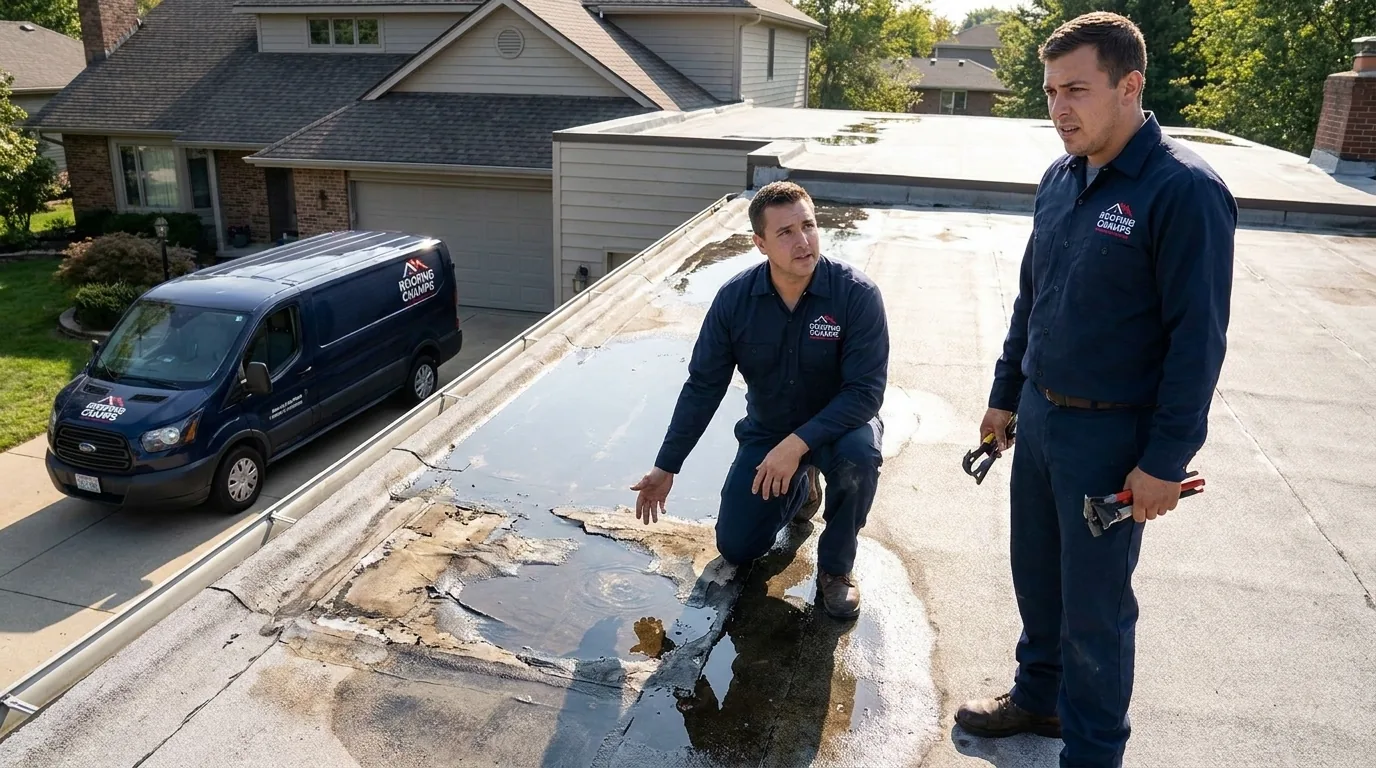
Flat and low-slope roofs need attention around drainage, seams, flashing, and roof penetrations. Roofing Champs helps homeowners request flat roof repair support.

  • Fast help for leaks and storm damage
  • Repair and replacement estimate requests
  • Simple online request process
  • Emergency leak help available
Roofing Champs roofing help for homeowners
Roof repair, replacement, and inspections Emergency leak help available Fast estimate requests Homeowner-friendly process

Free roofing estimate request

Check roofing help in your area.

Start with your ZIP. We'll use the next step to understand the roof issue.

We'll confirm local availability before routing the request.

Flat Roof Repair request planning

Flat Roof Repair: What To Compare Before You Request Help

Flat Roof Repair planning: this page helps homeowners compare next steps for flat roof repair based on urgency, roof condition, visible damage, and whether the issue points to repair, inspection, or replacement.

Flat and low-slope roofs need attention around drainage, seams, flashing, and roof penetrations. Roofing Champs helps homeowners request flat roof repair support.

Ponding waterDrainage issuesMembrane wearSeam leaksFlashing damage

What happens after you request low-slope work

  1. We confirm your area and route the request to a local roofing pro.
  2. They reach out by your preferred method - phone, text, or email.
  3. You get a written scope and decide. No pressure, no contracts you didn't ask for.

Why homeowners use Roofing Champs

  • Free to request - no card, no contract
  • Local pros only - no out-of-state cold calls
  • Emergency requests flagged and prioritized
  • No fake reviews, no "#1" claims, no fake offices

Where we work

California (Bay Area, Central Valley, LA / South Bay, the Valley) and selected New Jersey communities (Cape May County, Gloucester, North Jersey).

Decision fit mapping

Repair, Inspection, or Replacement for Low-Slope Work

Choose repair when the damage is isolated.

Repair fits: Repair fits when ponding water is limited to one slope, one penetration, or one small area. The trade-off is a faster, narrower scope versus the possibility that nearby aged materials fail later.

Choose inspection when the cause is unclear.

Inspection fits: Inspection fits when drainage issues could be connected to flashing, ventilation, decking, or drainage. The trade-off is one more diagnostic step versus approving work before the true water path is known.

Choose replacement when failures repeat.

Replacement fits: Replacement fits when membrane wear appears together with age, repeated leaks, or multiple damaged slopes. The trade-off is higher upfront cost versus solving more of the roof system at one time.

For low-slope work, the useful first question is not "Can this be patched?" The useful question is whether the observed pattern points to a contained defect, an uncertain water path, or a roof-wide issue. ponding water and drainage issues

Quantified option differentiation

Numbers That Change the Recommendation

A same-day request matters when water is entering living space, electrical areas, or attic insulation. A 24-72 hour inspection window usually fits stains with no active dripping. A 15+ year asphalt roof with repeated leaks deserves a repair-versus-replacement comparison instead of another patch by default.

What To Compare

Compare flat roof repair options by ponding time, seam condition, membrane age, drain flow, flashing height, and number of penetrations. At the property, weather exposure and roof age changes how quickly a small defect can become a larger roof-system issue.

Technical feature to use case

Roof Details That Matter For The Job

Ponding time

Ponding time matters when water remains after rain stops.

Seams

Seams matter because low-slope roofs fail at joints before broad fields.

Drainage

Drainage matters when scuppers or drains clog.

Flashing height

Flashing height matters where flat roofs meet walls or parapets.

The most relevant detail here is not the part name; it is the situation where the part fails. For low-slope work, ponding water and drainage issues make the inspection focus different from a generic roof checklist.

Service areas

Popular local pages

Money page pathways

Service and Location Pages

Related guides

Related Roofing Guides

Questions homeowners ask

More Roofing Questions Answered

How much does a new roof cost?

A new roof often costs $8,000-$18,000 for a typical home, but pricing changes by roof size, slope, material, decking condition, tear-off needs, and local labor. Roofing Champs…

Read answer

How do I choose a roofing contractor?

Choose a roofing contractor by verifying current state license and insurance, getting at least three written estimates with line-item scope (not just totals), checking recent…

Read answer

What's the difference between architectural and 3-tab shingles?

Architectural shingles are thicker, dimensional, last 20-30 years, and rate for higher wind resistance than 3-tab shingles, which are flat, single-layer, and typically last 15…

Read answer

Is metal roofing worth it?

Metal roofing is often worth the higher upfront cost when you plan to stay in the home for 20+ years - service life runs 40-60 years versus 20-30 for asphalt, maintenance is g…

Read answer

How long does a roof last?

An asphalt shingle roof often lasts 15-25 years, depending on installation quality, ventilation, weather exposure, maintenance, and storm damage. Tile, metal, and slate can la…

Read answer
Answers for homeowners

Frequently Asked Questions

When do homeowners actually need low-slope work?

Usually when homeowners notice leaks, visible roof wear, storm damage, or some warning sign that they don't want to ignore until it gets worse. If you're on this page, your instinct is probably right - it's worth getting checked.

Can you help with urgent roofing requests?

Yes. Urgent leaks, storm damage, and emergency inspections use the same request process, with the urgency flagged for faster routing.

What affects the estimate?

Roof size, slope, materials, access, damage severity, decking condition, flashing complexity, ventilation needs, and project type all affect the written estimate.

What happens after I submit?

Your request goes to a local roofing pro with the issue, urgency, property location, and contact details. They reach out to schedule the next step - usually an inspection or written estimate. No commitment until you decide.

Start a Request

Start a roofing estimate request and get the next step moving.

Get My Free Roofing Estimate
Call Now for Roofing Help